

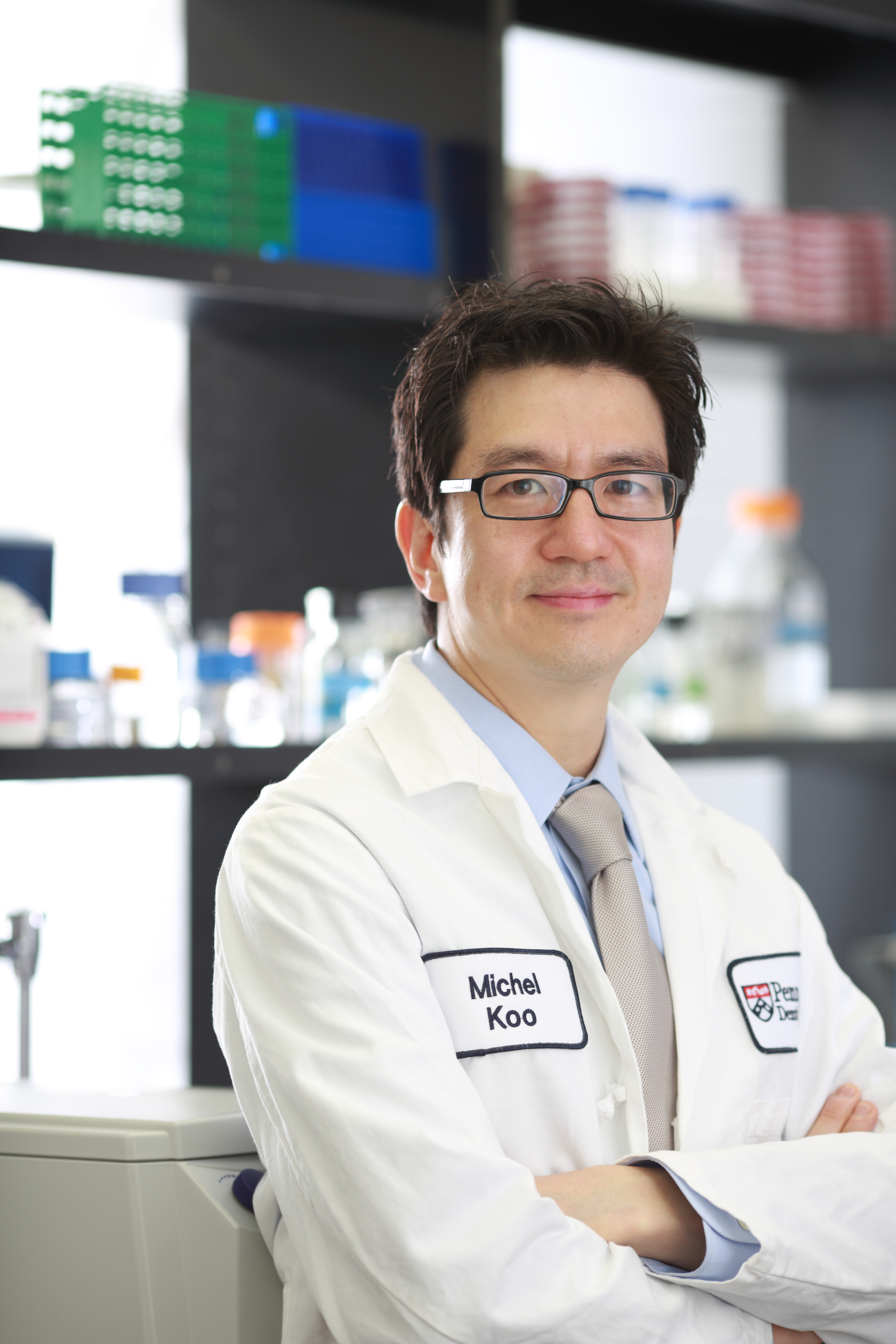
Hyun (Michel) Koo, DDS, MS, PhD
Dr. Koo is a dentist-scientist trained in food engineering and cellular microbiology, and an inventor with multiple patents. He is a professor in the schools of dental medicine and engineering at the University of Pennsylvania. As co-founder/director of the Center for Innovation & Precision Dentistry, he bridges clinicians, scientists, and engineers to advance oral and craniofacial health through research, training, and entrepreneurship. Dr. Koo also directs an NIDCR T90R90 training program at the intersection of dental medicine and engineering, focusing on disease mechanisms, affordable therapies, and precision diagnostics. His research explores how biofilm and microbiome interactions cause oral diseases as well as seeking new therapeutic and diagnostic approaches by integrating nanotechnology, material sciences, and robotics. He has published extensively in dental, biomedical, and multidisciplinary journals, including PNAS, Science, Nature Communications, Science Robotics, JCI as well as in Nature Reviews and Cell Press Trends journals. He is an elected AAAS fellow, the recipient of the IADR Distinguished Scientist and Innovation in Oral Care Awards, STAT nationwide finalist for Best Innovations in Science and Medicine, and Clarivate Highly Cited Researcher. He has served on several NIH panels and AADOCR/IADR scientific committees and has a career-long mentoring commitment with many of his trainees securing faculty and industry R&D positions in the U.S. and worldwide.
The Research Day keynote address is titled “Exploring Biofilm Microbiomes: Integrating Biology, Engineering, and Dentistry.” The study of oral biofilms has advanced the knowledge about the composition and spatial organization of the human microbiome. Microbes in biofilms form highly structured and organized communities that contain not only bacteria but also fungi and viruses. Importantly, the spatial organization dictates where microbes are located and associated to each other and with the host surfaces, which has direct implications on how the community functions to cause diseases in the oral cavity. This presentation discusses recent discoveries about the spatial structure of oral biofilms and new antibiofilm strategies by integrating the fields of biology, engineering, and AI, while sharing a personal journey as a dentist-scientist embracing multidisciplinarity in research and training.